Loading episode...
EP.29
Apr 20, 202600:19:31Season 1
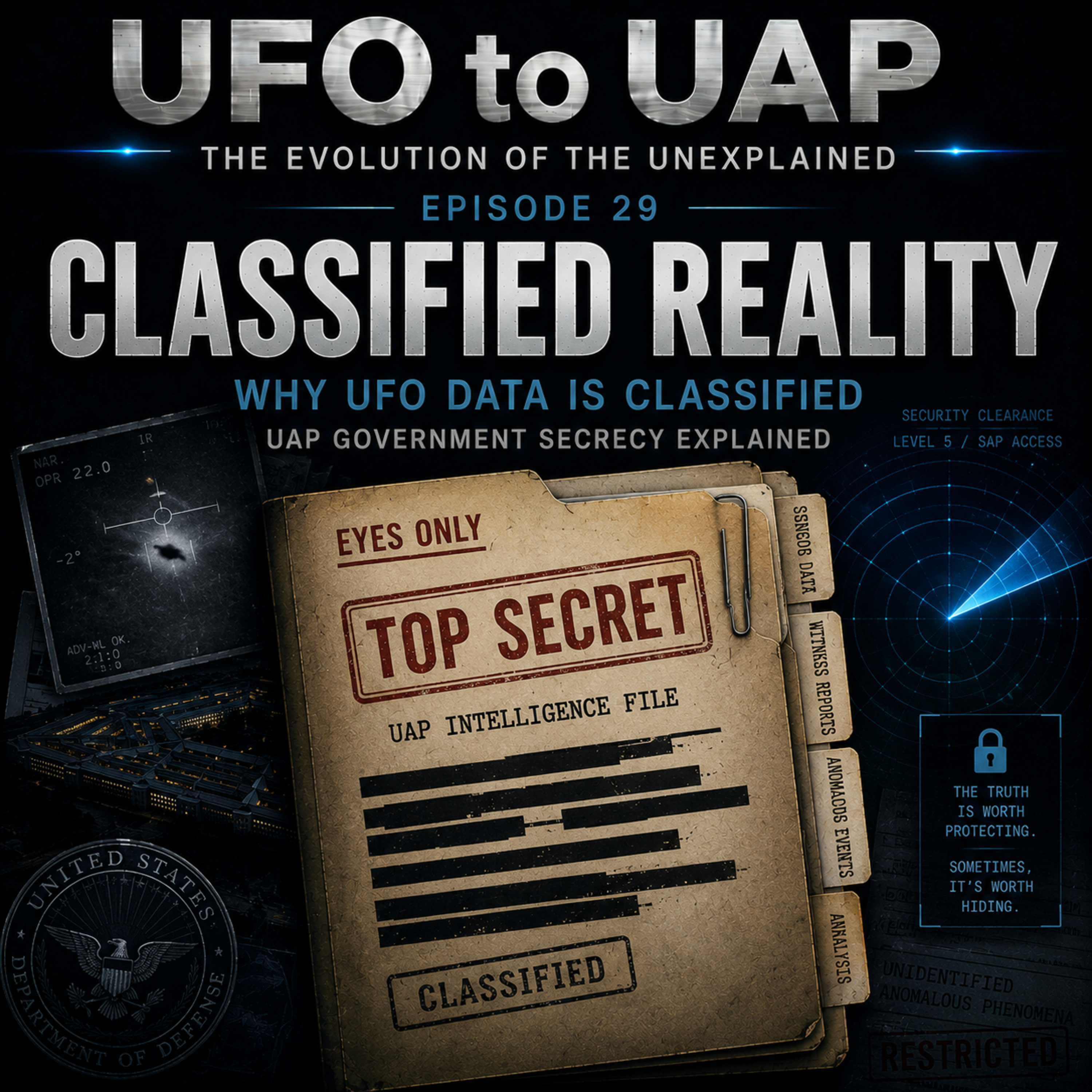
Classified Reality: Unveiling the Hidden UFO Data in Government Secrecy
0:00 / 0:00
// Show Notes
What does “classified” really mean—and why can the government possess UAP data without being able to reveal the full picture?
In this episode of UFO to UAP Explained, host Matt Tones investigates how national-security classification shapes what the public can know about UFO and UAP encounters. Rather than assuming officials hold one complete answer, the episode explores a more complex possibility: fragmented evidence spread across agencies, sensor systems, clearance levels and restricted programmes.
Discover why radar, satellite and infrared data may remain secret because releasing it could expose military capabilities, intelligence sources, detection limits and operational vulnerabilities. The discussion explains need-to-know access, compartmentalisation, legal restrictions and why senior authority does not always guarantee full visibility.
The episode also examines the difference between truth and intelligence. Government systems may not need to solve the UAP phenomenon; they may only need enough information to monitor behaviour, assess risk and protect strategic advantage. Is the public being denied a hidden truth, or does classified reality contain only partial data, competing interpretations and structured uncertainty?
Keywords:
classified UAP data, government UFO secrecy, national security classification, hidden UFO data, UAP intelligence, compartmentalised information, need-to-know access, military sensor data, radar UAP evidence, satellite surveillance, intelligence sources and methods, classified aerospace capabilities, government UAP investigation, structured uncertainty, operational security, Pentagon UFO data, UAP disclosure limits, unidentified anomalous phenomena, UFO government cover-up, UFO to UAP Explained.