Live
FollowLoading episode...
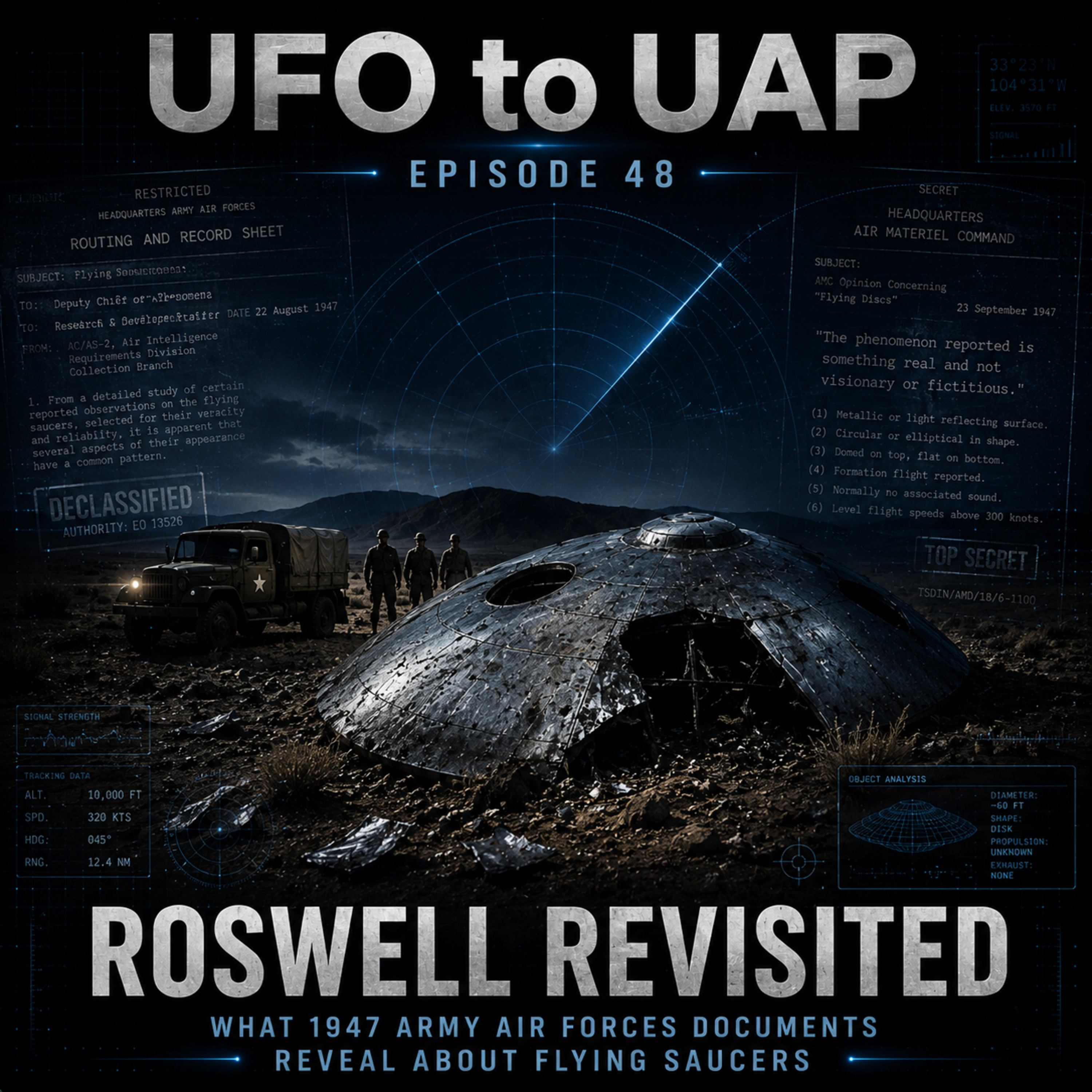
For nearly eighty years, the Roswell incident has been trapped in an unyielding cultural debate. In the public sphere, it is often framed as a conflict between extraordinary claims of crashed alien spacecraft and the official military retraction involving weather balloons, Project Mogul, and Cold War secrecy. For many, the story seemed completely closed in the summer of 1947. But behind closed doors, a very different narrative was unfolding within the United States military.
In this standalone episode of "UFO to UAP," host Matt Tones takes an objective, data-driven look past the sensational television documentaries and internet debates. Instead, we review the exact text and strategic implications of newly surfaced, highly classified 1947 Army Air Forces intelligence memoranda. These historical files don't just provide rumor; they show exactly how senior military officials processed the flying saucer phenomenon as a serious national security and intelligence problem in the weeks immediately following Roswell.
We dissect the remarkable August 1947 intelligence memorandum detailing reoccurring physical patterns—from metallic surfaces and circular, flat-bottomed shapes to formations traveling at estimated speeds exceeding 300 knots. Discover the internal scramble as investigators sought assurances that no domestic, classified American project accounted for these flight profiles.
Finally, we analyze the legendary September 1947 Air Materiel Command document from Wright Field. Containing one of the most famous declarations in government anomaly tracking, the memo officially concluded that the observed phenomenon was "something real and not visionary or fictitious". Learn how early intelligence networks mathematically evaluated these aerial anomalies against the aerospace limits of the era, balancing the possibilities of foreign threats, secret domestic testing, and the profound uncertainty that laid the groundwork for modern UAP analysis.
Episode