Loading episode...
EP.11
Apr 7, 202600:11:09Season 1
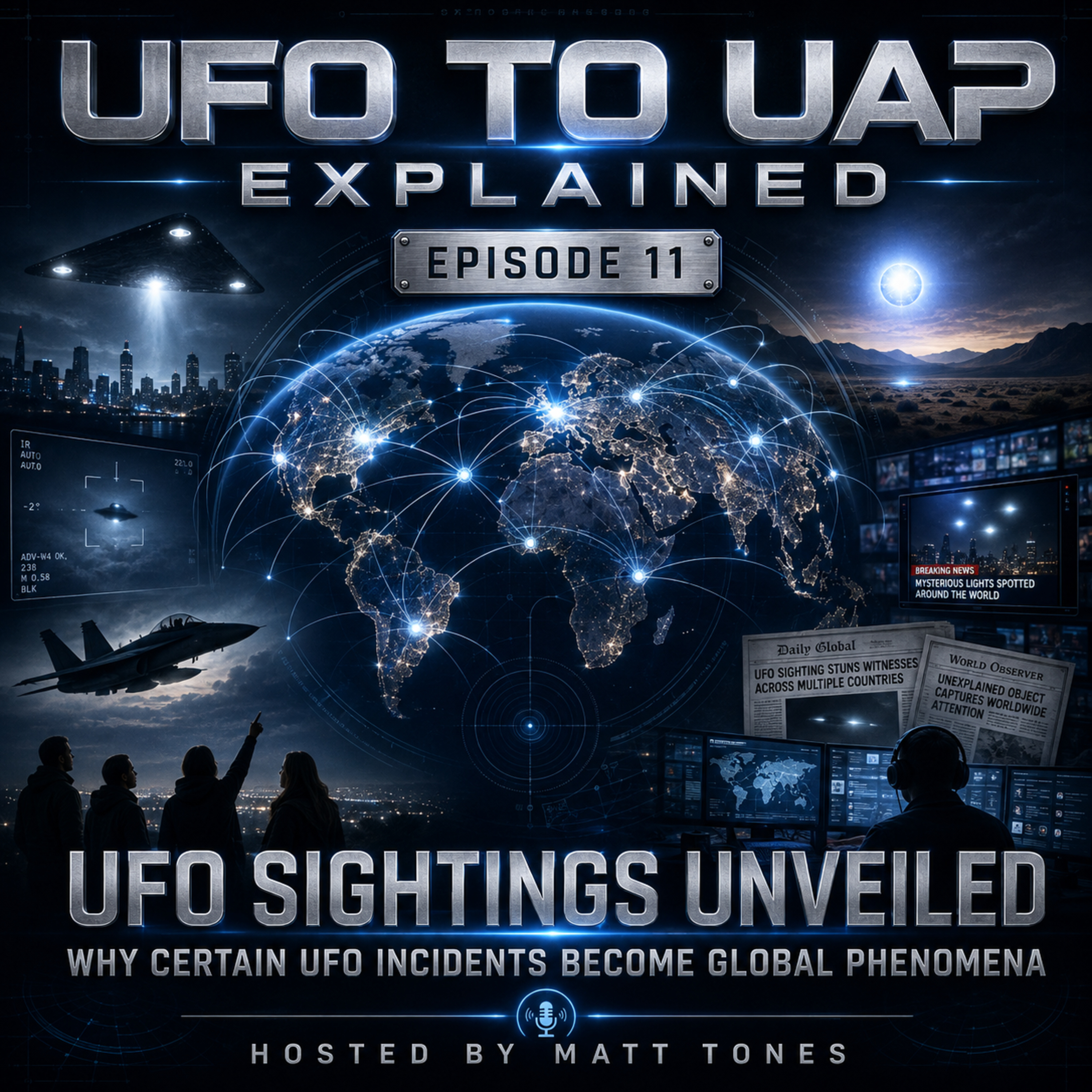
UFO Sightings Unveiled: Why Certain UFO Incidents Become Global Phenomena
0:00 / 0:00
// Show Notes
Why do some UFO sightings become global legends while thousands of others disappear from history?
In this episode of UFO to UAP Explained, host Matt Tones investigates the hidden forces that turn local UAP encounters into enduring worldwide phenomena. Comparing the 1952 Washington UFO sightings, the 1966 Westall incident, the Belgian UFO wave, the Ariel School encounter, the Phoenix Lights and the Kaikoura sightings, the episode reveals that famous cases are not always those with the strongest raw evidence.
Explore how simple narratives, multiple witnesses, radar data, military responses, schools, news crews and government attention help an event cross borders and survive for decades. The discussion separates two major traditions in UFO history: night-time cases shaped by radar, pilots and air-defence uncertainty, and daylight encounters preserved through dense groups of witnesses and shared memory.
The episode also examines media amplification, official reaction and feedback loops that can transform isolated reports into UFO waves. Are the most famous sightings evidence of stronger phenomena—or simply events that occurred where the greatest number of people and institutions could see, record and repeat them?
Keywords:
famous UFO sightings, global UFO phenomena, UFO cases that became legends, Washington UFO sightings 1952, Westall UFO incident, Belgian UFO wave, Ariel School UFO encounter, Phoenix Lights, Kaikoura UFO sightings, mass UFO sightings, military radar UFO evidence, school UFO encounters, UFO witness testimony, media amplification UFOs, government UFO response, UFO reporting waves, observational density, collective memory, unidentified anomalous phenomena, UFO to UAP Explained.