Loading episode...
EP.80
Sep 14, 202600:25:48Season 1
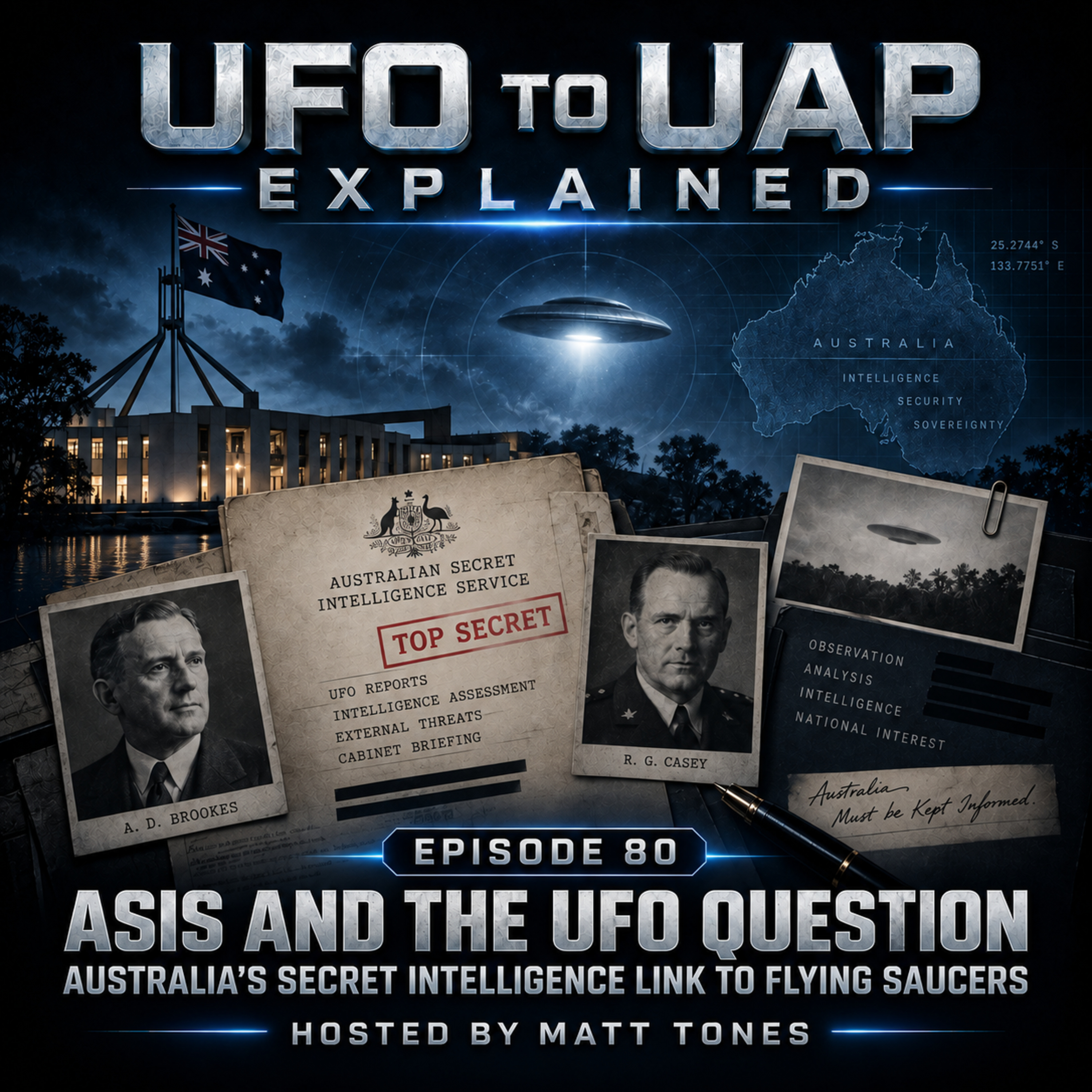
ASIS and the UFO Question: Australia's Secret Intelligence Link to Flying Saucers
0:00 / 0:00
// Show Notes
In 1954, Australia’s Foreign Minister Richard Casey was quietly seeking answers about flying saucers through official government channels. Inside National Archives file M1148 — Flying Saucers 1954 to 1955, one line changes the significance of the story: “Dictated over telephone by Mr. Brookes on 23/2/1954.” Alfred Deakin Brookes was then leading the Australian Secret Service, the organisation that would soon become ASIS. In Episode 80 of UFO to UAP Explained, we investigate how Australia’s founding foreign-intelligence chief became involved in passing information between Casey and Britain’s Directorate of Scientific Intelligence—and why that archival connection matters.
The investigation then jumps forward almost seventy years to the modern UAP era, where Australian Defence has confirmed receiving classified analysis from the United States while participating in Five Eyes discussions about unidentified anomalous phenomena. The episode separates what the evidence proves from what remains unknown: there is no public evidence of a dedicated ASIS UFO program, but there is a documented historical intelligence connection and a modern Australian role in allied UAP information sharing. The question is no longer simply whether Australian intelligence ever encountered the UFO issue—it is how much of that intelligence history remains outside the public record.
Keywords:
ASIS UFO, ASIS UAP, Australian UFO files, Alfred Deakin Brookes, Richard Casey UFO, Australian Secret Intelligence Service, Australian Secret Service, flying saucers Australia, Australian intelligence UFO, M1148 Flying Saucers, Australian government UFO files, Five Eyes UAP, classified UAP intelligence, Australia UAP, Australian Defence UAP, UFO intelligence, UAP intelligence sharing, British Directorate of Scientific Intelligence, UFO history Australia, UFO to UAP Explained
// Episode Transcript
UFO TO UAP EXPLAINED — EPISODE 80
ASIS AND THE UFO QUESTION
Australia's Secret Intelligence Link to Flying Saucers
Hosted by Matt Tones
Production note: Citations and source notes are not intended to be read aloud.
February 23rd, 1954.
A telephone conversation somewhere inside the Australian government is being turned into a memorandum.
The page is ordinary. Typed text. Government language. No dramatic headline. No photograph of an object in the sky. No witness describing impossible manoeuvres.
But the subject is flying saucers.
Australia's Minister for External Affairs, Richard Casey, has been asking questions. Not through newspapers. Not through a civilian UFO organisation. Through government channels.
Information has travelled to Britain. There, Casey's material has reached an official inside the British Ministry of Defence's Directorate of Scientific Intelligence. A response has come back. The British official is sceptical. Meteors may explain many reports. He wants to see the Australian data. The Australian intermediary offers to keep the exchange moving.
Then, right at the bottom of the page, almost as an administrative afterthought, appears the line that changes the significance of the document.
“Dictated over telephone by Mr. Brookes on 23/2/1954.”
Mr Brookes was Alfred Deakin Brookes.
And Alfred Brookes was not simply another public servant.
At that moment he was running Australia's secret foreign-intelligence organisation. Technically, in February 1954, it was still called the Australian Secret Service. Later that year it would be transferred to the Department of External Affairs and renamed the Australian Secret Intelligence Service.
ASIS.
Australia's overseas spy service.
For more than twenty years, even the existence of that service would remain largely outside public view.
And yet here, inside an Australian government file devoted to flying saucers, is its founding chief. Not observing a UFO. Not claiming aliens. Doing something much more consistent with the world of espionage. Obtaining information from overseas. Connecting an Australian minister with British defence intelligence. And quietly asking what another government knew.
Seventy years later, Australia would again seek information from an ally about unidentified objects. This time the terminology would be UAP. The ally would be the United States. And the answer would be classified.
So tonight, we follow one document. One name. One intelligence connection. And one question that refuses to disappear:
Was Alfred Brookes's involvement in 1954 simply a moment of Cold War curiosity—or was the UFO subject already becoming an intelligence problem?
Today's Episode Sponsor: GrowMyPod.com.
I'm Matt Tones. And this is UFO to UAP Explained.
THE PAGE AT THE CENTRE OF THE STORY
The archival file is M1148 — Flying Saucers 1954 to 1955. Forty-three pages survive in the publicly available record.
The file documents an unusual moment in Australian political history when Richard Casey took a personal interest in the flying-saucer question. Casey wanted answers. Not necessarily extraterrestrial answers. He wanted to know what serious people inside government, science and defence thought was happening.
Australian diplomatic posts were approached. Scientific opinions were sought. CSIRO personnel entered the correspondence. Information was gathered from overseas.
The file is not evidence of an Australian government conclusion that flying saucers were alien spacecraft. It is evidence of something more grounded. Senior government figures were asking questions. And they were using the machinery available to them to obtain answers.
Now return to that February memorandum. Casey's material had been passed through a British contact to G. L. Turney, an official in the Ministry of Defence's Directorate of Scientific Intelligence. Turney's reaction was hardly sensational. He believed many nighttime flying-saucer reports could probably be explained by meteors or meteorites. He was wary of claims built on weak data. But one thing caught his attention. The Australians appeared to be suggesting a correlation between sightings and periods of meteor activity. Turney wanted to see the figures.
The response returned to Australia. And Brookes offered to continue acting as intermediary.
Then the notation:
“Dictated over telephone by Mr. Brookes.”
No fanfare. No extraordinary conclusion. Just a bureaucratic line.
But now we know who Brookes was. And suddenly the page looks different.
THE MAN WHO WAS SUPPOSED TO REMAIN INVISIBLE
To understand why that name matters, we have to move back two years.
May 1952. The Cold War is hardening. The Korean War is underway. Australia is increasingly dependent on secret intelligence from allies, but the government also wants an overseas collection capability of its own.
Prime Minister Robert Menzies authorises the creation of the Australian Secret Service. The first man appointed to run it is Alfred Deakin Brookes.
Former ASIS Director-General Paul Symon later described Brookes as his predecessor and said the founding organisation had two principal responsibilities. Collect foreign intelligence overseas. And prepare to conduct special operations when required.
Secrecy was not incidental. It was central to the design.
ASIS's own official history says the service was formed in 1952, initially concentrating on overseas intelligence, particularly in the Asia-Pacific. Its existence remained secret for more than twenty years. It was first mentioned in Parliament in 1975 and formally acknowledged in 1977.
Now imagine that environment. No public website. No recruitment advertising. No annual explanation of what the agency did. No ordinary Australian would see Brookes on television explaining his mission. This was an organisation designed to gather information quietly.
And in February 1954, its chief appears in a flying-saucer file.
That does not mean Brookes was running a secret UFO unit. Nothing I have found supports that. The more interesting interpretation is also the more defensible one. Brookes appears to have been doing exactly the kind of work his organisation existed to do. Foreign liaison. Obtaining information that an Australian policymaker wanted from overseas. The extraordinary part is simply the subject. Flying saucers.
WHAT DID CASEY ACTUALLY WANT?
It would be easy to turn Richard Casey into a believer. The documents do not justify that. His behaviour looks more investigative than ideological. He wanted information. He wanted expert opinion. He wanted to know whether reports that seemed extraordinary survived scrutiny.
And the responses he received were frequently sceptical. That matters. Because it tells us this was not a conversation taking place entirely inside a belief system. Government scientists and defence officials were looking for ordinary explanations. Astronomical objects. Meteors. Atmospheric effects. Aircraft. Misidentification. Poor observation.
But there is another layer. In the early 1950s, an unknown object in the sky had strategic meaning even if extraterrestrials never entered the discussion. Aircraft technology was accelerating. Radar was transforming air defence. The Soviet Union was an adversary. Secret weapons programs existed. Guided missiles were developing rapidly.
If something entered controlled airspace and you could not identify it, someone had to ask:
Was it ours? Was it theirs? Was it natural? Was it an error? Or was there simply not enough information to know?
That is where the UFO problem begins to overlap with intelligence. Not at the point where somebody believes in aliens. At the point where the answer is:
We don't know whose object that is.
THE DOCUMENT BECOMES A MOTIF
Look again at the memorandum. It does not contain proof of anything exotic. In fact, the British assessment pushes in the opposite direction. Turney was sceptical. He wanted data. He believed conventional explanations could account for many reports.
But intelligence work is not necessarily about confirming extraordinary claims. It is about reducing uncertainty.
Brookes did not need to believe that flying saucers were spacecraft. Casey did not need to believe it either. If another government possessed relevant information, that information could still be useful.
And that is why the memo matters. Not because it tells us what UFOs were. Because it tells us who was asking.
CASEY'S INVESTIGATION WIDENS
The Brookes exchange was not the entire story. The M1148 file shows Casey's office gathering information through broader diplomatic and scientific channels. Australian posts overseas were involved. CSIRO scientists were consulted. British expertise was sought.
The documents suggest a government attempting to establish whether there was anything substantial beneath the flood of flying-saucer reports emerging internationally.
Elsewhere inside the Commonwealth bureaucracy, the Royal Australian Air Force was building its own process for unusual aerial sightings. Reports were being collected. Witnesses questioned. Aircraft and astronomical explanations considered.
Australia was not operating one grand, central UFO investigation agency. The evidence instead shows overlapping systems. Air Force intelligence dealing with reports in Australian skies. Scientists considering physical explanations. External Affairs seeking information overseas. And now, in at least one documented instance, the head of the secret foreign-intelligence service assisting with that international information flow.
That distinction is important. It prevents us from inventing a program that the evidence does not show. But it also prevents us from understating what the records actually reveal. Australian intelligence leadership was not completely detached from the flying-saucer question. Alfred Brookes is physically present in the paper trail.
ASIS AND ASIO ARE NOT THE SAME THING
There is another distinction worth making because the names are constantly confused.
ASIO is the Australian Security Intelligence Organisation. Its focus is security intelligence relating to threats affecting Australia.
ASIS is Australia's overseas human-intelligence agency. Today, ASIS describes itself very plainly: Australia's overseas human intelligence collection agency. Its work involves obtaining highly sensitive information from sources overseas.
So if an Australian government minister wanted to know what officials inside another country privately understood about an unusual aerospace issue, foreign intelligence would be a natural place for that question to intersect with government.
That does not tell us whether ASIS later continued collecting UFO-related information. It tells us why Brookes's involvement in 1954 is institutionally plausible. He was not chasing lights across Australia. He was helping Australia ask questions overseas.
And then— the trail becomes much harder to follow.
THE ARCHIVE GOES DARK
With the RAAF, we can follow thousands of pages. Files have titles such as Reports on Flying Saucers and Other Aerial Objects. There are policy documents. Witness reports. Regional files. The bureaucracy announces what the material is about.
Then you reach ASIS. And the landscape changes.
The National Archives says ASIS transfers records in response to researcher requests. For security reasons, only a small number of ASIS records are publicly available. Researchers can request access to historical ASIS material, but the agency's archival footprint is nothing like the old Air Force collection.
The relevant archival agency is CA 5582.
This is where the investigation reaches the edge of what can currently be seen. The public record gives us Brookes. The date. The memo. The British intelligence contact. And then— very little.
That silence must be interpreted carefully. It does not prove a hidden UFO program. Silence is not evidence of secret spacecraft. But with an intelligence organisation, silence also cannot safely be interpreted as proof that nothing happened.
Relevant material might never have been created. It may remain closed. It may sit inside records described under foreign liaison, scientific intelligence, defence technology or another subject entirely. Or Brookes's involvement may genuinely have ended with this exchange.
We do not know. And saying we do not know is not a weakness. It is the point at which evidence ends.
LISTENER QUESTION
So here is the question I want you to think about.
If historical ASIS records from the 1950s no longer expose living sources, operational methods or current capabilities, should Australia conduct a targeted review for material relating to flying saucers, unidentified aircraft and foreign government investigations?
Because either result would matter. If nothing else exists, we learn that Brookes's involvement was limited. If more material exists, we discover that Australia's foreign-intelligence interest went further than currently understood. Both outcomes improve the historical record.
SEVENTY YEARS LATER
Now imagine the page disappearing. The typewriter stops. The M1148 file closes. Decades pass. Flying saucers become UFOs. UFOs become UAP. ASIS remains largely beyond public view. The Cold War ends. New strategic competition begins.
And then, almost seventy years after the Brookes memorandum, Australia again asks an ally what it knows about unidentified objects.
In February 2023, Chief of Air Force Air Marshal Robert Chipman told Senate Estimates that Australia had sought additional information from the United States. The follow-up answer eventually emerged in Defence records.
“The United States military released classified analysis to Defence.”
Australia's Air Commander had also provided a classified summary of relevant Air Force capabilities. Defence described existing intelligence, surveillance and reconnaissance systems, operational reporting networks, aircrew, air battle managers and intelligence officers as pathways through which an unusual observation could be communicated and analysed.
Then came another piece. A Five Eyes UAP meeting. Australia initially produced an answer indicating it had not attended a United States UAP briefing. Later Defence records clarified the situation. A Defence representative at the Australian Embassy in Washington had attended the Five Eyes UAP forum in May 2023.
United States AARO documents describe that meeting as the inaugural Five Eyes UAP Caucus Working Group. Australia, Canada, the United Kingdom and New Zealand appeared in the partner-update section of the agenda. The discussion included detection. Identification. Mitigation. Information sharing. And future collaboration.
And suddenly the 1954 document echoes. Not because the events are identical. They are not. Not because modern ASIS involvement has been established. It has not. But because the strategic question sounds familiar.
What do our allies know about unidentified objects that we do not?
THE PARALLEL — AND THE LIMIT
This is where we have to resist the temptation to join dots that the evidence does not connect.
We have a documented historical ASIS precursor connection in 1954. We have documented modern Australian Defence involvement in Five Eyes UAP discussions. We have classified U.S. analysis supplied to Australian Defence.
But we do not have evidence proving ASIS participated in the modern UAP forum. We do not know that ASIS currently collects UAP intelligence. We do not know what was inside the classified American analysis.
And classified does not mean extraterrestrial. Information can be classified because it reveals radar capability. Sensor coverage. Intelligence sources. Collection methods. Foreign military technology. Operational vulnerabilities. Or simply what another government knows about a platform it is trying to identify.
The responsible conclusion is therefore narrower. Australia has twice, separated by nearly seven decades, used international government and intelligence relationships to obtain information connected with unidentified aerial phenomena. In 1954, Alfred Brookes is directly documented in that process. In the modern Five Eyes story, ASIS itself remains unconfirmed. That boundary matters.
WHAT WOULD ASIS DO IF THE QUESTION AROSE TODAY?
ASIS's current mission provides an interesting hypothetical. The service collects secret intelligence overseas that supports Australian national interests.
So imagine a foreign government has investigated an unusual aerospace system. Australian policymakers want to know what that government really thinks. Is it a drone? A surveillance platform? A classified weapons program? A sensor problem? A hostile state's technology? Or an observation that still resists identification?
Those are foreign-intelligence questions. They concern information held overseas. They concern what another government knows privately rather than what it says publicly. ASIS is institutionally capable of collecting that kind of intelligence.
But capability is not evidence of tasking. There is no public basis for saying ASIS has been ordered to investigate UAP today. And that sentence is as important as everything that came before it. Because the strength of this story lies in what we can prove. Not in what we can imagine.
THE ONE LINE THAT SURVIVED
Return one last time to February 1954. The memo. The final line.
“Dictated over telephone by Mr. Brookes…”
When that page was created, nobody writing it could have known how strange that sentence would look seventy years later. Brookes was doing his job. Casey was asking questions. British scientific intelligence was responding. The answer was sceptical. No alien revelation emerged. No extraordinary technology was confirmed.
But the page survived. And because it survived, we can now establish something with certainty. The UFO issue reached at least one of the highest figures in Australia's newly created foreign-intelligence structure. That is not mythology. That is archival history.
FINAL LISTENER QUESTION
And this is the question I want to leave with you.
When governments encounter something they cannot identify, what matters more— what they publicly call it? Or who they quietly ask for answers?
Because names change. Flying saucer. UFO. Unidentified aerial phenomenon. Unidentified anomalous phenomenon. The vocabulary evolves. But intelligence has always been interested in the same problem. The unknown.
CONCLUSION
UFO history is usually told through sightings. A pilot looks out of a cockpit. A radar operator watches a return. A witness sees a light cross the sky. But behind those observations is another history. A quieter history. The movement of information. Who collected it. Who classified it. Who compared it with intelligence from another country. Who asked scientists for an explanation. And who decided the unknown was important enough to investigate.
In February 1954, Richard Casey wanted information about flying saucers. Alfred Deakin Brookes helped obtain it. Brookes was leading the Australian Secret Service—the organisation that would soon become ASIS. The request reached the British Ministry of Defence's scientific-intelligence structure. A response came back. Sceptical. Interested in the data. Open to further exchange.
That alone does not give us an Australian secret UFO program. But it gives us something more valuable than speculation. A documented intelligence connection. A date. A file. A named official. And a question transmitted across national borders.
Nearly seventy years later, Australia once again asked an ally for information about unidentified objects. The United States supplied classified analysis. Australian Air Force capabilities were assessed. Five Eyes partners met to discuss UAP. We cannot prove that modern ASIS is part of that story. But we can prove Australia is once again inside an international intelligence conversation about the unidentified.
So perhaps Episode 80 does not end with an answer. Perhaps it ends where good intelligence work often begins. With a gap. Between what the government once recorded— and what the public can currently see. Between the one memorandum that survived— and whatever may have existed around it. Between the classified information Australia receives today— and the small portion of that information that eventually reaches us.
There may be nothing more. There may be another document sitting somewhere in the archive. Another memo. Another name. Another connection.
But until evidence emerges, we stay with what the record can support.
On February 23rd, 1954, the man leading Australia's secret foreign-intelligence service dictated a memorandum about flying saucers. And seven decades later— that single line is still asking questions.
I'm Matt Tones. This has been UFO to UAP Explained. Episode 80. ASIS and the UFO Question: Australia's Secret Intelligence Link to Flying Saucers.
Until next time— keep watching the skies. But more importantly— keep following the paper trail.
END OF EPISODE
SOURCES — NOT FOR READ-ALOUD
- National Archives of Australia — History of Australian intelligence and security. Establishes that the Australian Secret Service emerged in 1952, was transferred to External Affairs and renamed ASIS in 1954, and explains access arrangements for ASIS archival records and agency CA 5582.
- Australian Secret Intelligence Service — Official history and mission. Confirms formation in 1952, its overseas intelligence role, and that the service remained secret for more than twenty years.
- Paul Symon, former Director-General ASIS — 70th anniversary speech. Identifies Alfred Deakin Brookes as Symon's predecessor and describes the organisation's original foreign-intelligence mission.
- National Archives file M1148 — Flying Saucers 1954 to 1955, barcode 3215027. Forty-three-page file documenting Richard Casey's flying-saucer enquiries. The archival reproduction contains the 23 February 1954 memorandum concerning G. L. Turney of Britain's Directorate of Scientific Intelligence and the notation that it was dictated by Mr Brookes.
- Project 1947 — Australian government records research. Documents Casey's personal interest, overseas enquiries and scientific correspondence associated with M1148.
- Australian Department of Defence — FOI 710/23/24 and related Senate Estimates material. Confirms the United States military released classified analysis to Defence, the Air Commander produced a classified capability summary, and describes existing RAAF ISR and reporting pathways.
- Australian Department of Defence — later Senate Estimates/FOI records. Confirms that a Defence representative at the Australian Embassy in Washington attended the May 2023 Five Eyes UAP forum and documents the earlier inconsistent attendance response.
- U.S. All-domain Anomaly Resolution Office — Five Eyes UAP Caucus records. Confirms the May 2023 working-group framework and the participation of Five Eyes partners in discussions concerning UAP detection, identification, mitigation and future collaboration.