Loading episode...
EP.81
Sep 15, 202600:44:25Season 1
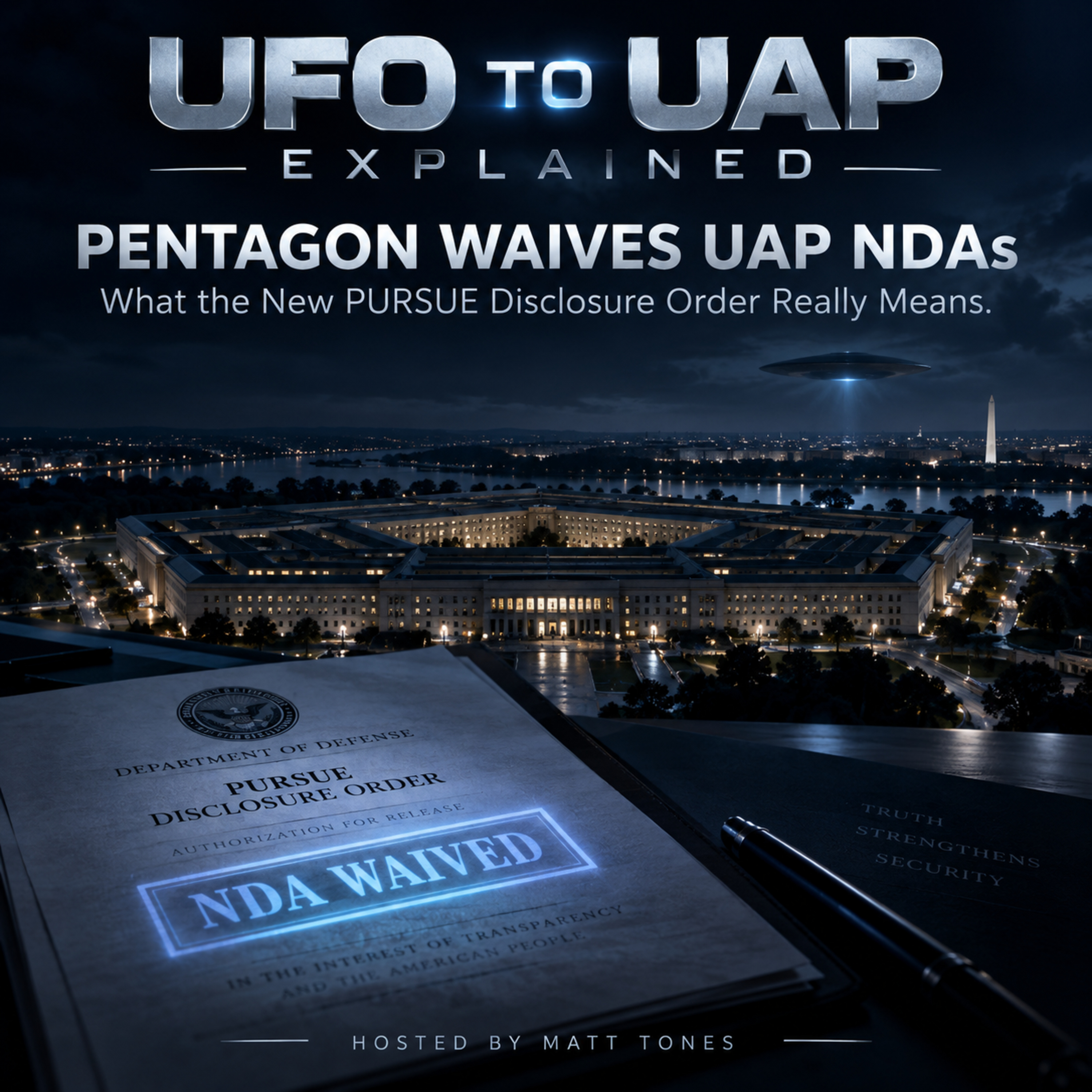
Pentagon Waives UAP NDA's: What the New PURSUE Disclosure Order Really Means
0:00 / 0:00
// Show Notes
The Pentagon has issued a new legal waiver allowing certain current and former military personnel, government employees and defence contractors with UAP-related National Defense Information to disclose protected information to authorised PURSUE representatives. In PENTAGON WAIVES UAP NDAs: What the New PURSUE Disclosure Order Really Means, Matt Tones investigates what the September 2026 UAP disclosure order actually changes, why it specifically addresses nondisclosure agreements and Special Access Program Indoctrination Agreements, and whether this could finally open a pathway for insiders with firsthand knowledge of classified UFO or UAP programs to come forward.
This episode examines the new PURSUE disclosure process, its connection to existing UAP whistleblower protections, AARO’s reporting mechanism, David Grusch’s 2023 congressional testimony and allegations involving crash retrieval and reverse-engineering programs. Crucially, the waiver does not publicly declassify UAP information or give personnel permission to reveal classified material to journalists or podcasts. Instead, it creates an authorised government channel for protected disclosures—raising a much bigger question: if firsthand witnesses to secret UAP programs really exist, what happens when they finally use it?
Episode Sponsored by GrowMyPod.com
Keywords:
Pentagon UAP NDA waiver, PURSUE UAP, UAP disclosure 2026, Pentagon UFO disclosure, UFO NDA waiver, UAP whistleblower, UFO whistleblower, David Grusch, Special Access Programs, SAP UAP programs, classified UAP programs, UFO crash retrieval, UAP reverse engineering, AARO, Pentagon UFO files, UAP government disclosure, UFO disclosure, UAP transparency, defence contractors UFO, classified UFO programs, UAP National Defense Information, Pentagon UAP investigation, UFO government secrets, UAP news, UFO news.
// Episode Transcript
PENTAGON WAIVES UAP NDAs
What the New PURSUE Disclosure Order Really Means
UFO TO UAP EXPLAINED — EPISODE 81
There are moments in the UAP story when the important development is not a photograph.
Not a radar return.
Not another shaky video filmed somewhere over the ocean.
Sometimes...
the most important development is a piece of paper.
A few paragraphs. A legal instruction. Words written inside government that quietly change what another person is allowed to say.
And on September 14, 2026, the United States Department of War issued one of those documents.
A targeted legal waiver. Its purpose was unusually specific.
Current and former military personnel. Government civilians. Contractors. People who have—or previously had—access to UAP-related National Defense Information. People who may have signed nondisclosure agreements. People who may have entered Special Access Programs. People who, until now, may have looked at the documents they signed years ago and wondered...
“If I speak... what happens to me?”
The Department has now given them an answer. At least... if they speak to the right people.
Because the Pentagon has not thrown open the doors to every classified UAP program in the United States. It has not told witnesses they can go onto television and reveal classified information. It has not declassified alleged crash-retrieval programs. It has not confirmed extraterrestrial spacecraft. And it has not proved that any of the extraordinary allegations made during the last several years are true.
But it has done something that could become extremely important.
It has created an explicitly authorised route for people holding protected UAP information to speak directly to representatives of the government's new disclosure effort... PURSUE.
And perhaps the most consequential words in the entire announcement concern the agreements those people signed. Nondisclosure agreements. And Special Access Program Indoctrination Agreements. The Department says that certain civil and administrative enforcement provisions contained within those agreements will no longer block authorised disclosures to PURSUE.
That distinction matters enormously.
Because for years, the UAP debate has contained an almost impossible contradiction. Government investigators have repeatedly asked witnesses to come forward. Some witnesses have claimed they cannot speak because the information is classified. Others have claimed their nondisclosure agreements prevent them from revealing what they know. Congress has heard allegations concerning hidden programs. AARO has said it has investigated extraordinary claims but has not found empirical evidence proving that the United States possesses extraterrestrial technology.
And somewhere between those positions... there has always been the same question.
What happens if someone actually knows something... but believes the legal consequences of talking are greater than the protections offered for coming forward?
On September 14... Washington attempted to remove part of that barrier. And now... we find out whether anyone walks through the door.
I'm Matt Tones. And this is UFO to UAP Explained.
Today we are examining the Pentagon's new UAP NDA waiver... what it actually says... what it absolutely does not say... why the reference to Special Access Programs is significant... how this connects to David Grusch and years of whistleblower allegations... and the question that may matter most of all: If there really are people inside government or the defence industry who possess firsthand knowledge of extraordinary UAP programs... what excuse remains for not reporting it now?
THE DOCUMENT
Start with the language. Because this story becomes distorted very quickly if we move beyond the actual words.
On September 14, the Department of War announced what it described as a targeted legal waiver connected to UAP disclosure. The mechanism exists within PURSUE. The Presidential Unsealing and Reporting System for UAP Encounters.
PURSUE is the Trump administration's government-wide effort to identify, review and potentially release historical and contemporary UAP material. Since May 2026, the PURSUE website has been publishing tranches of government records. Documents. Videos. Images. Historical files. Material from multiple agencies. Five releases had appeared by early August.
But those releases dealt primarily with information already held by government. This new action deals with something different. People. People who may know where information exists. People who may know what programs existed. People who may understand how something was classified. Or perhaps people who believe important information never entered conventional UAP reporting systems at all.
The September 14 announcement states that current and former Department of War service members, civilian personnel and contractors who hold—or previously held—access to UAP-related National Defense Information may disclose protected information directly to official PURSUE representatives.
Then comes the sentence that changes the story.
The Department says the waiver supersedes civil and administrative enforcement provisions contained within nondisclosure agreements... and Special Access Program Indoctrination Agreements... for communications directed to PURSUE.
Read that carefully.
It does not say... “Everything you know is now public.”
It says... “There is an authorised place where you can tell us.”
That is a very different thing. And understanding that difference may be the key to understanding what happens next.
THE FIVE-MINUTE QUESTION
Before we go deeper, if you're following this story with me and you value episodes where we separate what the documents actually say from what social media says they say... take a moment to subscribe or follow UFO to UAP Explained. And if you know someone who has been following the disclosure debate, share this episode with them. Because this particular story is moving quickly... and the difference between an NDA waiver and public declassification is already being blurred online. The more people who understand that distinction... the better this conversation becomes.
Now... let's get into why that distinction matters.
THIS DIDN'T BEGIN ON SEPTEMBER 14
The September announcement did not appear from nowhere. The machinery had already begun moving weeks earlier.
On July 31, 2026, Principal Deputy Director of National Intelligence Aaron Lukas signed a memorandum titled: Preliminary Guidance for Implementation of NDA Waiver.
That memorandum was distributed across the American intelligence community. CIA. DIA. NSA. NGA. NRO. FBI. Department of Energy. Department of Homeland Security. State Department intelligence. Military intelligence components. Army. Navy. Air Force. Space Force. Marine Corps. Coast Guard. And others.
The July memorandum instructed the Department of War and intelligence community to establish a process so current and former government employees and contractors possessing relevant UAP information could speak with authorised representatives of AARO or PURSUE... without prior nondisclosure agreements, agreements, oaths or commitments preventing that authorised communication.
It also told intelligence-community organisations to establish PURSUE designees. And to inform their workforces that the reporting channel existed.
That matters. Because July was the policy direction. September appears to be part of the implementation. The concept moved from: “We intend to establish a path.” toward: “Here is the legal waiver establishing the path.”
That doesn't make the pathway perfect. It doesn't guarantee every witness trusts it. It doesn't guarantee every agency implements it identically. And it certainly doesn't guarantee extraordinary information exists.
But bureaucratically... this is movement. And in government... bureaucratic movement can matter more than dramatic language. Because ultimately... disclosure does not happen because someone posts a mysterious photograph. Disclosure happens when information can legally move from one compartment... to another... to investigators... to review... to declassification... and eventually, perhaps... to us.
WHY NDAs MATTER
To understand the significance of the waiver, we need to understand what a nondisclosure agreement actually does.
In national-security work, secrecy is not an optional courtesy. People receive access to classified information because they agree to protect it. Sometimes the information concerns intelligence sources. Weapons. Operations. Surveillance capabilities. Foreign governments. Nuclear information. Technical systems. Military vulnerabilities. And sometimes... Special Access Programs.
A Special Access Program—usually shortened to SAP—is designed for information requiring safeguards beyond ordinary classified controls. Access can be extraordinarily limited. Knowing that a program exists does not necessarily mean you are authorised to know what it does. Working inside one compartment does not mean you can access another. And individuals granted access can sign specific agreements acknowledging those obligations.
That is where the September language becomes interesting. Because the Department did not merely mention generic NDAs. It specifically referenced Special Access Program Indoctrination Agreements.
That should not be interpreted as confirmation that a secret extraterrestrial reverse-engineering SAP exists. There is no such confirmation in this announcement. But legally and procedurally, the language matters because some of the most serious allegations in the modern UAP debate have revolved around exactly that kind of compartmented environment. Programs allegedly hidden inside other programs. Contractors holding material. Restricted access lists. Information allegedly withheld from normal oversight.
Again... allegations. Not established facts. But allegations that have repeatedly reached Congress. Which brings us back to 2023.
DAVID GRUSCH AND THE PROBLEM OF ACCESS
On July 26, 2023, three witnesses appeared before a United States House Oversight subcommittee. Former Navy commander David Fravor. Former Navy pilot Ryan Graves. And former intelligence officer David Grusch.
Fravor described the now-famous 2004 Tic Tac encounter involving the USS Nimitz carrier strike group. Graves spoke about UAP encounters reported by military aviators and the stigma surrounding them. But Grusch brought a different kind of allegation. Not simply unexplained objects in the sky. Programs.
According to Grusch, during his work involving the UAP Task Force, he encountered information suggesting that the United States possessed a longstanding crash-retrieval and reverse-engineering effort involving objects of alleged non-human origin. He also told Congress that he had suffered retaliation.
Those claims electrified the UAP debate. They also created an immediate evidentiary problem. Much of what Grusch described publicly was not material he could simply place on the hearing-room table. Some of the information was classified. Some claims involved programs that would themselves be classified if they existed. Some testimony could only be discussed in a secure environment.
Critics argued that extraordinary allegations without publicly available evidence could not be independently verified. Supporters responded that classification itself prevented witnesses from producing the evidence critics demanded.
And so the debate became trapped inside a loop. Show us the evidence. I can't. It's classified. Then we can't verify the claim. Exactly.
That loop has never really disappeared. But the legal architecture around authorised UAP reporting has been developing in parallel. In fact, Congress had already passed legislation establishing a secure mechanism for people with information concerning UAP-related government programs to make authorised disclosures. Federal law specifically contemplated information involving things like... material retrieval. Material analysis. Reverse engineering. Research and development. Detection and tracking. Operational testing. Security protections. Even special and compartmented access programs.
The law says an authorised disclosure made through the designated mechanism is not subject to the individual's NDA. And it provides protections against reprisal.
So why issue another waiver now? That is the fascinating question.
LAW ON PAPER VERSUS CONFIDENCE IN PRACTICE
There is a difference between a legal pathway existing... and potential witnesses believing that pathway is safe.
Think about the psychology of a person who has spent twenty years inside classified systems. Their career may have depended on one rule above almost everything else: Do not disclose protected information to someone who is not authorised to receive it.
Maybe they signed an NDA. Maybe they signed a SAP indoctrination agreement. Maybe they were told repeatedly that unauthorised disclosure could destroy their career. Perhaps expose them to prosecution. Perhaps cost them their clearance. Perhaps affect their pension, contracts or reputation.
Then years later... someone says: “Come forward. You're protected.”
Would you trust it? Would your lawyer? Would your former employer? Would the contractor whose program you worked inside agree? Would you want the protection written specifically enough that there could be no ambiguity?
This is where the September waiver becomes more significant than its length suggests. It directly addresses the agreements themselves. The Pentagon is now explicitly telling covered people that, when communicating with official PURSUE representatives under this mechanism, those specified NDA and SAPIA enforcement provisions will not be used as the barrier preventing disclosure.
That may sound bureaucratic. But imagine being the person holding the information. For that person... bureaucracy is the entire issue. The difference between talking and remaining silent might come down to one question: “Can someone punish me for violating the document I signed?”
The new order is designed to make the authorised answer clearer. Not if you use this channel properly.
BUT THERE IS A VERY IMPORTANT LIMIT
This waiver is not a licence to disclose classified information publicly. That point deserves repeating.
It does not authorise someone to appear on a podcast... open a classified folder... and begin reading. It does not authorise classified documents to be posted online. It does not mean a person can disclose sensitive program details to journalists. It does not automatically declassify anything. It does not erase the classification system.
It creates a protected government channel. The September Department announcement describes information flowing to designated PURSUE representatives for systematic review... security evaluation... and potential declassification. Potential. That word matters.
A witness may report something extraordinary... and the public may still never see it. There could be legitimate national-security reasons. Sources and methods. Foreign intelligence. Weapons capabilities. Personal privacy. Nuclear restrictions. Or investigators may determine the information is inaccurate. Misunderstood. Already accounted for. Or unrelated to anything anomalous.
So when you see headlines saying: “Pentagon removes UFO secrecy.” No. That goes too far.
The more accurate description is: The Pentagon has reduced a specific legal barrier preventing certain current and former personnel from providing protected UAP information to an authorised disclosure mechanism.
Less dramatic. Much more important.
THE STRANGE POSITION AARO NOW OCCUPIES
There is another tension here. AARO already operates a reporting channel. Its website invites current and former government employees, service members and contractor personnel with firsthand knowledge of UAP-related government programs or activities dating back to 1945 to report what they know. AARO explicitly says it may receive UAP-related information at all classification levels... including information involving special access and compartmented programs.
The initial online form itself is not designed for classified information. Instead, it acts as a point of contact. AARO can then arrange a secure interview or further communication.
So again... why PURSUE?
Part of the answer appears to be mission. AARO's mandate is investigation and resolution. PURSUE's mandate includes identifying government-held UAP material for review and possible declassification and public release. Those missions overlap... but they are not identical. Think of AARO as an investigative office. PURSUE is increasingly functioning as a disclosure pipeline. And now the government is explicitly routing potential witnesses into both systems.
That creates an extraordinary test. Because AARO has previously stated that its historical investigation found no empirical evidence that the United States government or private companies had been reverse-engineering extraterrestrial technology. Its 2024 historical report said many allegations could be traced to misunderstanding of genuine classified programs... circular reporting... or claims unsupported by verifiable evidence.
That conclusion remains part of the official record. But critics of AARO have argued that some witnesses were reluctant to participate fully... that access problems existed... or that people holding the most sensitive information might not trust the office.
Whether those criticisms are fair or not... PURSUE now creates another pathway. And that means the government's own claims can be tested. If there really are dozens of firsthand witnesses... people who physically handled anomalous material... people who worked inside concealed reverse-engineering programs... people who saw craft... people who know program names... budget lines... locations... contractors... security structures... then the reporting barrier has just become harder to cite as the explanation for silence. Not impossible. But harder.
THE MOST IMPORTANT QUESTION
Here is the question I think everyone should be asking.
Not: “Does this prove aliens?” It doesn't.
Not: “Does this prove David Grusch was right?” It doesn't.
Not: “Does this mean disclosure is imminent?” We don't know.
The important question is: What happens when someone uses it?
Suppose tomorrow... a retired intelligence officer contacts an authorised PURSUE representative. That person says: “I worked inside a UAP-related Special Access Program.” PURSUE verifies the individual's identity. Checks their access history. Confirms that the program existed. The witness provides program names. Locations. Personnel. Documents. Maybe physical records. Maybe sensor data. Maybe contract information.
What happens next? The answer will tell us much more about the seriousness of this initiative than any press release.
Does the information disappear into another classified compartment? Does PURSUE investigate it? Does AARO receive it? Does Congress receive notification? Does the government review the underlying records for declassification? Does anything reach WAR.GOV/UFO? And most importantly... does the public ever learn that the disclosure occurred?
Because a reporting mechanism can be legally meaningful... while remaining almost completely invisible from outside government. We may never know how many witnesses use it unless the administration publishes statistics... announces resulting investigations... or releases records generated through those disclosures.
That should become the next transparency benchmark. Not simply: “Did you create a waiver?” But: “How many people used it?” How many disclosures were considered credible? How many involved special access programs? How many resulted in records being located? How many resulted in declassification? How many were resolved as conventional programs? How many remain unexplained?
Those numbers could transform this from a political announcement... into an auditable transparency process.
WHAT IF NOTHING HAPPENS?
There is another possibility. Maybe the waiver exists... and almost nobody comes forward. That outcome would matter too.
For years, public discussion has included claims that large numbers of insiders possess direct knowledge of extraordinary UAP programs but remain silent because of secrecy agreements. If those individuals now have an explicitly authorised route... and the anticipated wave of testimony does not materialise... we would need to consider what that means.
Perhaps people still don't trust the process. Perhaps the protections are considered insufficient. Perhaps relevant programs fall outside the scope people expected. Perhaps witnesses fear reputational consequences even if legal consequences are reduced. Perhaps potential witnesses want congressional rather than executive-branch channels.
Or... perhaps the population of insiders possessing extraordinary firsthand information is smaller than some narratives have suggested.
Every outcome provides information. That is why the next year could be more important than the announcement itself. The waiver is not evidence of recovered craft. The behaviour that follows the waiver... might become evidence about the claims surrounding recovered craft. There is a difference. And it is a difference worth watching closely.
THE CONTRACTOR QUESTION
Now we arrive at one of the hardest parts of this issue. Contractors.
For decades, speculation about hidden UAP programs has often involved private aerospace and defence companies. The theory usually works like this: Move material out of government. Place it with private industry. Protect it through contracts and compartmentation. Reduce exposure to freedom-of-information requests. Keep knowledge distributed among very small groups.
Again... that is a theory. There is no publicly verified evidence establishing that an American corporation is secretly storing extraterrestrial spacecraft. But government law and reporting mechanisms explicitly contemplate contractors because contractors genuinely do handle highly classified national-security programs.
The September waiver includes current and former Department contractors who hold or previously held access to UAP-related National Defense Information. That makes the contractor language important. But it does not automatically solve every problem.
A contractor may have signed multiple agreements. Some obligations may involve different agencies. Some information may involve intellectual property. Some may involve nuclear information. Some records may be corporate rather than government-owned. Some people may be unsure whether the waiver covers the specific agreement they signed.
And the September announcement itself refers specifically to civil and administrative enforcement provisions associated with covered NDAs and SAPIAs for communication with PURSUE. Those details will matter to lawyers. And they will matter enormously to any potential witness considering disclosure.
So we should resist the temptation to say: “The NDAs are gone.” They're not. The better description is: A legally authorised exception has been created for defined UAP communications through a defined government channel. That may be enough. Or it may expose new gaps. We are about to find out.
WHY SPECIAL ACCESS PROGRAMS KEEP APPEARING
One phrase in this release deserves particular attention: Special Access Program Indoctrination Agreements.
The reason isn't aliens. The reason is oversight.
Federal UAP law already contains provisions specifically addressing restricted-access activities, Special Access Programs and compartmented access programs. The legislation anticipates the possibility that UAP-related reporting could intersect with extraordinarily sensitive programs. And it contains a remarkable requirement. If an authorised disclosure concerns a restricted-access activity or special program that has not been explicitly and clearly reported to the relevant congressional defence or intelligence committees... the law requires notification.
That matters because one of the most serious allegations made during the modern UAP debate has never simply been: “There are secret programs.” Of course there are secret programs. Every major military power has them. The extraordinary allegation has been: “There are secret UAP programs operating without proper congressional oversight.”
That is a different claim. And it is potentially a constitutional and oversight issue regardless of what those programs contain.
Imagine, for example, that an undisclosed program turned out not to involve extraterrestrial technology at all. Suppose it involved a highly classified surveillance platform. A drone. Foreign-material exploitation. Advanced propulsion research. Or an intelligence operation. If that program were legally required to be reported to congressional oversight committees... and wasn't... that would still be significant.
This is why the UAP question cannot be reduced to: “Aliens or no aliens?” There are layers. Flight safety. Intelligence collection. Foreign technology. Classification. Oversight. Contracting. Whistleblower protection. Scientific anomalies. And somewhere inside all of those layers... possibly... a genuinely unexplained residue.
THE RELEASE PIPELINE
This also changes how we should watch future PURSUE releases. Until now, the public releases have largely been interpreted as an archive. What old records will the government release next? What videos? What documents? What photographs?
But after this waiver... PURSUE potentially becomes something else. An intake system.
Imagine the sequence. A witness comes forward. PURSUE receives a protected disclosure. Investigators identify associated records. Those records are located. Classification authorities review them. Sensitive details are redacted. Documents are cleared. And months later... something appears on WAR.GOV/UFO.
If that happens... we may not initially know the release began with a human source. Which means from this point onward, every new PURSUE tranche deserves a different kind of scrutiny. Not just: “What's in the document?” But: “Why was this document selected?”
Did it emerge from an archive review? A congressional request? An agency search? An AARO investigation? Or from someone finally coming forward under the new waiver? That provenance could become as important as the document itself.
THE GRUSCH TEST
Which brings us back to David Grusch. Since 2023, his allegations have occupied a strange place in American public life. They were delivered under oath before Congress. They were extraordinary. They were widely reported. And yet the most consequential evidence has remained outside public view.
Grusch has repeatedly maintained that he provided information through authorised government channels. AARO's historical assessment, meanwhile, has rejected the broader claim that the government has verified extraterrestrial reverse-engineering programs. Those positions remain in tension.
The new waiver does not resolve it. But it creates an opportunity for additional firsthand witnesses—if they exist—to test both narratives. If people with direct knowledge can now speak to PURSUE... then investigators should be able to compare independent testimony. Do witnesses identify the same program? The same facility? The same contractors? The same dates? The same personnel? Can their access be verified? Do budget documents exist? Are there classified records? Do archival references match? Can claims be corroborated without witnesses knowing each other's testimony?
That is how extraordinary allegations become investigable. Not through belief. Not through ridicule. Through convergence. Independent evidence. Documents. Names. Dates. Access records. Physical evidence. Sensor data. And repeatable corroboration.
If PURSUE receives that... we have a major story. If it doesn't... that is information too.
THE DANGER OF OVERSELLING THIS
There is a temptation with every UAP development to declare: “This is disclosure.” We've heard it for decades. Hearings were disclosure. AARO was disclosure. Whistleblowers were disclosure. Videos were disclosure. PURSUE was disclosure. The NDA waiver is disclosure.
Maybe. But disclosure is not a single event. It is a process. And processes can stall. They can be captured by bureaucracy. They can become political theatre. They can generate enormous expectations and very little evidence.
So we need a standard. A simple one. Does this change the amount or quality of verifiable information available?
Today... the waiver itself changes the conditions under which information can move inside government. That is significant. But the ultimate test comes later. Do new witnesses emerge? Does new evidence appear? Do new records reach the public? Does the government resolve longstanding allegations? Does Congress gain meaningful oversight?
Those are the outcomes that matter. Until then... this is a door opening. Not proof of what is behind it.
AND YET...
There is something undeniably unusual about where this debate has arrived.
Go back twenty years. Imagine telling someone that one day the United States government would operate an official UAP office... publish military UAP imagery... pass federal legislation describing reporting of programs involving material retrieval and reverse engineering... create protections for people making authorised UAP disclosures... launch a presidential UAP record-release system... and then issue a waiver explicitly referencing nondisclosure agreements and Special Access Program Indoctrination Agreements for UAP reporting.
They might have thought you were describing fiction. Today... those things exist in government documents.
That does not mean the extraordinary hypothesis is true. But it tells us something important. The institutional response to UAP has changed. The subject is no longer merely: “Did someone see a UFO?” The question has moved into law. Policy. Intelligence oversight. Classification. Military reporting. Archives. Government contracting. And now... the legal agreements signed by people inside secret programs.
Whatever the ultimate explanation of UAP becomes... the investigation itself has become historically significant.
WHAT I WILL BE WATCHING NEXT
There are now several things worth watching very carefully.
First... whether the Department publishes detailed procedures identifying exactly how eligible witnesses contact authorised PURSUE representatives.
Second... whether other intelligence-community agencies issue their own implementation notices following the July ODNI directive.
Third... whether AARO modifies its public reporting guidance to reference the new waiver.
Fourth... whether Congress asks how many disclosures are received under the mechanism.
Fifth... whether witnesses publicly confirm they have used it.
And sixth... whether future PURSUE releases contain material that can be traced back to those disclosures.
That last one could be critical. Because the significance of this order may not become visible tomorrow. It may appear quietly... months from now... inside a document released without fanfare. A program name. A memorandum. A contractor reference. A briefing slide. A sensor recording. A declassified interview. Something that exists publicly only because someone was finally told: “You can tell us.”
FOUR QUESTIONS
And I want to leave you with four questions.
First... if firsthand witnesses to extraordinary UAP programs really exist, does this waiver remove enough legal uncertainty for them to come forward?
Second... if they do come forward, should the government publish statistics showing how many disclosures PURSUE receives and what happens to them?
Third... if no significant new witnesses emerge, should that reduce our confidence in claims that large numbers of insiders have been silenced primarily by NDAs?
And fourth... if credible information does emerge... how much should the government be expected to reveal publicly when national-security classification still applies?
Those questions are no longer hypothetical in quite the same way they were before. Because now... there is a mechanism. There is a waiver. And there is an invitation.
CONCLUSION
For decades, the mythology surrounding government UFO secrecy has contained the image of a person trapped by an oath. Someone who knows. Someone who saw. Someone who worked inside the program. But someone who signed a document... and therefore remains silent.
Maybe that person exists. Maybe thousands of them exist. Maybe almost none do. We don't know.
But on September 14, 2026, the United States government changed the equation. It told certain current and former personnel and contractors possessing UAP-related National Defense Information that they have an authorised channel to PURSUE. It explicitly addressed nondisclosure agreements. It explicitly addressed Special Access Program Indoctrination Agreements. And it created a path intended to move protected information into government review... security evaluation... and potentially... declassification.
This is not proof of alien technology. It is not confirmation of crash retrievals. It is not public declassification. It is not permission to reveal classified information to journalists.
But it is significant. Because for years... one of the central explanations for the absence of firsthand public evidence has been secrecy. NDAs. Classification. Fear. Now the government is attempting to remove at least one layer of that barrier.
Which means the next phase of the UAP story may not be about what the Pentagon releases. It may be about who decides to speak. And what happens... when they do.
I'm Matt Tones. This has been UFO to UAP Explained.
If you found this investigation useful, follow the podcast so you don't miss the next development. And share this episode with someone who has been following the UAP disclosure story... because the next PURSUE release may look like another document dump. But after this waiver... we should be asking a different question. Who gave them the document? And why... is it being released now?
Until next time... keep looking at the evidence. Keep questioning the claims. And keep watching the process. Because sometimes... the most important thing in the sky... isn't in the sky at all. Sometimes... it's buried inside the paperwork.